

READ TIME: 6 MINUTES | WORDS: 1,337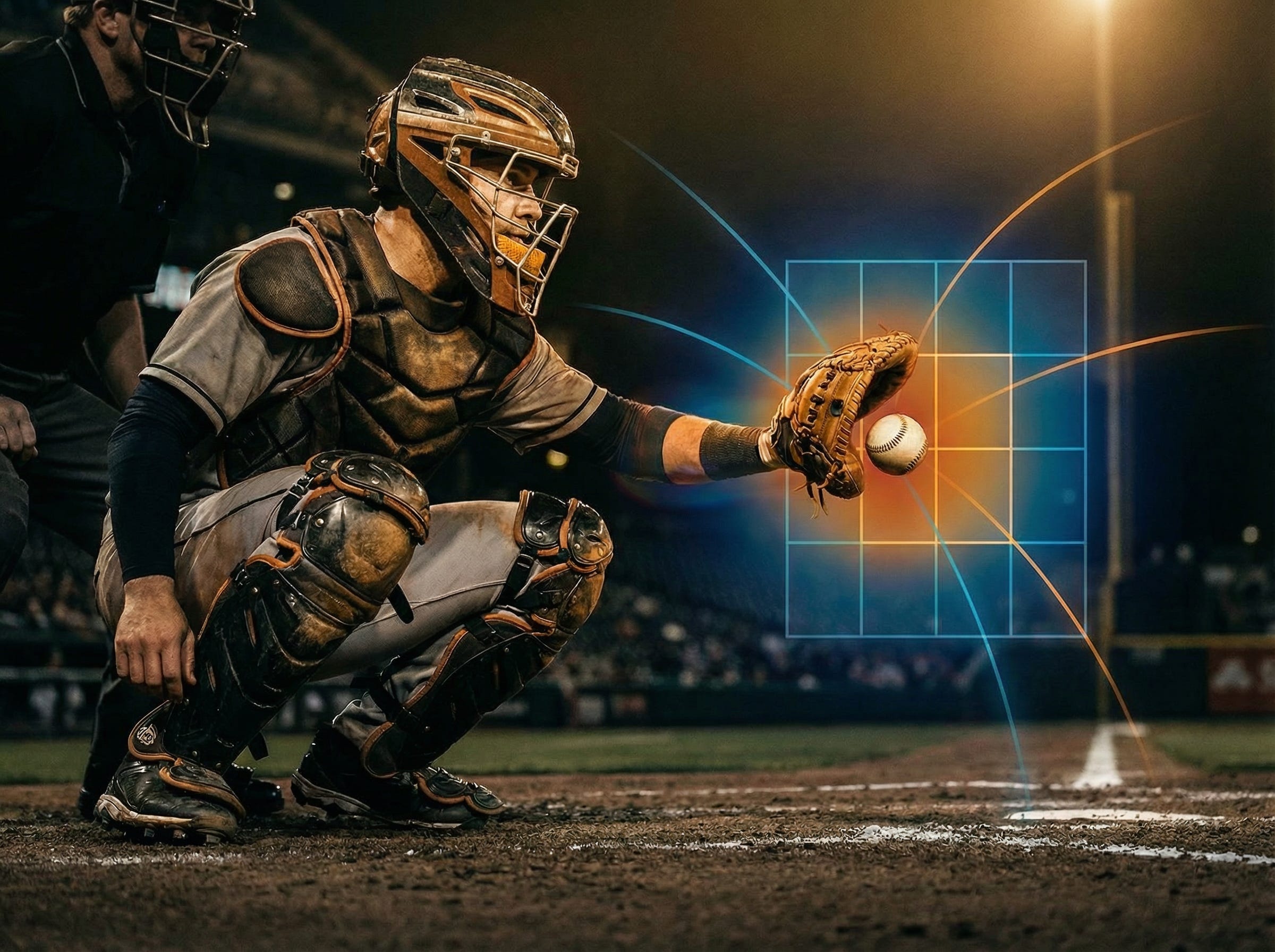
MLB's best metric for catcher framing — Catcher Framing Runs on Baseball Savant — says the gap between the best and worst catchers in 2024 was about 26 runs.
Patrick Bailey at +16.
Korey Lee at -10.
A new machine learning model says the real gap was over 110 runs.
That's not a typo. That's not a rounding error.
That's a fundamental mismeasurement of an entire position.
WHY IT MATTERS
A study published in SABR's Baseball Research Journal by Mizzou physicist Charles Steinhardt and sophomore Zach Borowiak built an XGBoost model trained on 3.5 million Statcast pitches from 2019–2024.
The model scores every pitch by expected run value, then isolates:
What the pitcher did
What the hitter did
What the catcher influenced — separately.
The catcher findings blew the doors off the existing numbers.
➞ Catcher Framing Runs (CFR; the current standard)
CFR measures one thing: did the catcher turn a ball into a called strike?
That direct effect ranges from about -10 to +16 runs per season.
It's the number teams use to value defensive catchers.
It's the number that justified giving Austin Hedges $4 million despite being one of the worst hitters in baseball.
But the model found that the total catcher effect — including the indirect behavioral impact on hitters — ranged from -50 to +61 runs in 2024.
If correct, the difference between the best and worst catchers was over 11 wins last season.
ZOOM IN: The Part Nobody Was Measuring
Here's where it gets interesting.
When a catcher with elite framing consistently gets that pitch an inch off the plate called a strike, hitters notice.
Not consciously, maybe — but over the course of a game, they start adjusting.
They expand their zone. They swing at pitches they normally wouldn't.
And those swings tend to produce weak contact.
The catcher isn't just stealing a strike call.
He's reshaping the hitter's mental model of the strike zone as he adapts to the zone the catcher is creating, not the rulebook zone.
➞ The Data Backs This Up:
The best framing catchers induce significantly more swings outside the rulebook strike zone than the worst ones.
Hitters are swinging at pitches they shouldn't be swinging at, because the catcher has conditioned them to believe those pitches will be called strikes.
The old metrics missed this entirely.
Those extra swings — the ones the hitter takes because the catcher expanded the effective zone — produce worse outcomes.
But since the umpire never makes a call on them (the hitter swung), they don't show up in Catcher Framing Runs.
The existing metric counts the stolen call — it doesn't count the downstream damage.
The model estimates this behavioral effect is worth an additional 15–20 runs per year for elite framers, on top of the ~15 runs they were already getting credit for.
➞ In The Context of ABS
The fear has been that the challenge system would erode catcher framing value — if every borderline call can get overturned, why does it matter if your catcher makes a ball look like a strike?
We broke down the ABS Challenge System's early data and found that only about 1% of pitches get challenged.
The system's impact is behavioral, not mechanical — it changes how hitters think about the zone, not the outcome of individual pitches.
This study reveals the same mechanism running in the other direction.
ABS tightens the zone, and hitters stop chasing.
An elite framer expands the zone, and hitters start chasing.
Same behavioral lever, opposite pull.
ABS can correct a call — it can't correct the swing decision the hitter already made because the catcher reshaped his zone all game.
The part of framing value that ABS threatens — the stolen call itself — turns out to be the smaller piece of the total.
The bigger piece, the behavioral cascade, doesn't get overturned by a challenge.
ZOOM OUT: Hitters Guess, Catchers Exploit
The framing-plus-behavioral effect isn't even the full story. The study also found evidence that pitch calling — the sequencing of pitches — is a separate, roughly equal source of catcher value because the model proved that hitters guess.
When a pitcher throws the same pitch back-to-back, hitters actually perform worse — they guessed wrong, expecting something different.
When that same pitch shows up again later in the at-bat with a different pitch in between, hitters perform better — they'd seen it earlier and adjusted.
The logical explanation: hitters aren't just reacting.
They're predicting what's coming next, and that prediction shapes their swing decisions before the pitch even arrives.
Though Ted Williams endorsed this approach in The Science of Hitting, coaching culture still treats "guess hitter" as a pejorative.
But this model shows the best hitters in the world are doing it — and the data says they're not guessing enough.
If hitters improved their approach to back-to-back repeated pitches alone, it would be worth roughly 1.8 to 4.1 wins per team per season.
➞ The Other Side of the Guessing Game
On the other side of hitters trying to anticipate what pitch is coming is the catcher calling pitches.
Pitch calling value in the model: up to 25–30 additional runs per year for the best catchers.
Uncorrelated with framing ability: a great framer isn't necessarily a great pitch caller, and vice versa.
The rare catcher who does both? Jake Rogers saved 61 runs in 2024, according to this model.
That's equivalent offensive value to what earned Juan Soto his $765 million contract(!).
And pitch calling doesn't care about ABS at all.
The challenge system corrects ball-strike calls. It has nothing to say about whether the catcher called for a changeup when the hitter was sitting fastball.
THE BOTTOM LINE
If this model holds, the "bad hitter, elite catcher" archetype isn't absorbing an offensive cost — he's potentially one of the highest-value contracts in baseball per dollar spent.
Because the stolen strike was never the whole story.
Behind every one is a behavioral cascade — hitters expanding their zone, chasing more, making weaker contact — that doubles or triples the real defensive value.
The team that finds a catcher who frames and calls a game has an advantage that existing metrics have been drastically undervaluing for over a decade.
The question was never whether ABS would kill framing.
The question is whether we ever measured the full scope of what framing was doing in the first place.
DIG DEEPER
There's an ironic wrinkle and fascinating subplot that played out in spring training.
Yardbarker's Jay Staph ran the early ABS challenge numbers and found the best framers in baseball are actually worse at using the system so far.
The top five framers last season: 58.6% challenge success rate.
The bottom five: 61.5%.
➞ Trevor May’s Theory
The former MLB reliever has stated that it’s possible the elite framers have gotten so good at making balls look like strikes that they've started fooling themselves.
They frame a pitch just off the plate, their brain registers it as a strike, they challenge — and the robot says no.
The very skill that creates the behavioral value this study identified is now a cognitive blind spot when a machine gets the final word.
Catchers are learning they can't necessarily always trust their own perception of the zone they've been manipulating for years.
By The Numbers
+61 to -50 runs: Full catcher score range in 2024, vs. +16 to -10 for Catcher Framing Runs alone
11+ wins: Estimated gap between the best and worst catchers
15–20 runs/year: Additional value from the behavioral effect (hitter zone expansion) that existing metrics don't capture
25–30 runs/year: Pitch calling value for the best catchers — uncorrelated with framing skill
3.5 million pitches: XGBoost model training data (2019–2024 Statcast)
58.6% vs. 61.5%: ABS challenge success — best framers vs. worst framers
➞ The Study
Borowiak presented the research at Undergraduate Research Day at the Missouri Capitol earlier this year.